

F5 Products
Rayan Nik Tajhiz Company
Most-viewed websites and widely used software have several servers and use Load Balancing technology to divide the traffic between servers.
Introduction
You might think that the web servers of huge companies like Google and Microsoft cannot be managed by a few servers and ordinary network cards because the daily processing of billions of requests requires a lot of spare capacity and powerful servers. Load Balancing technology is suitable for increasing efficiency and speed in network affairs.
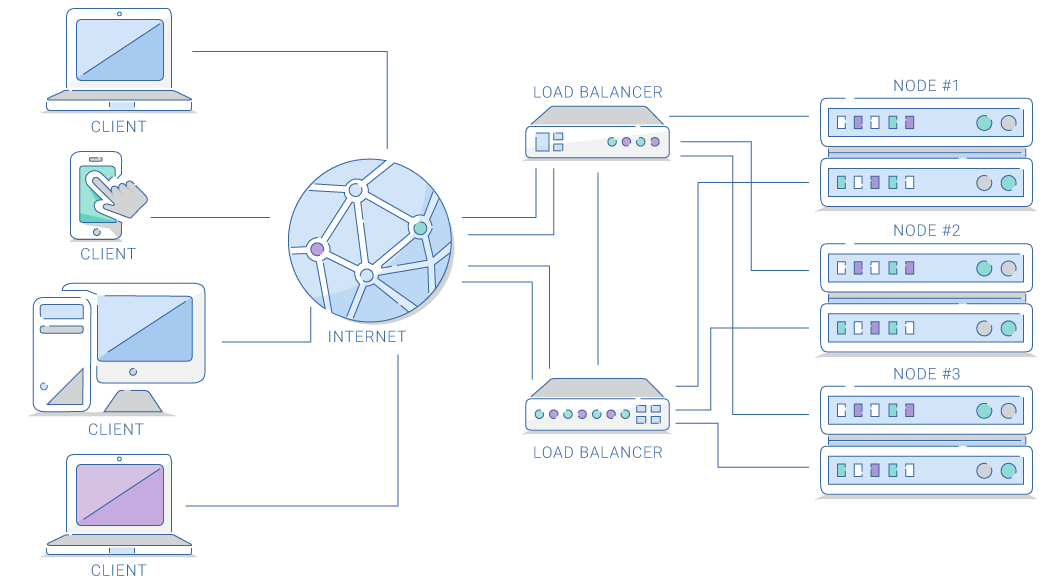
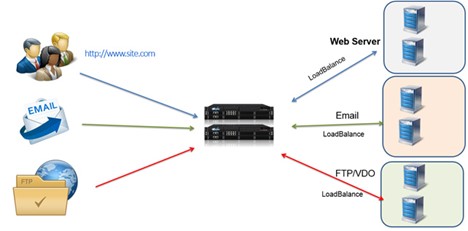
Load balancing means the distribution of processing and communication activities equally on the main servers, including the mail server, in such a way that no processing load is applied on any single server that exceeds the permissible limit or is inconsistent with other servers. As a result, performance reduction and processing pressure are prevented on a server.
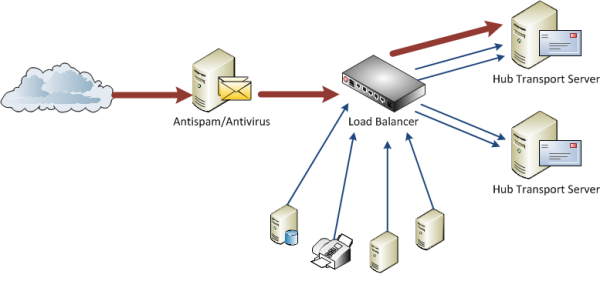
Load Balancing makes the load balanced on the servers in such a way that the requests are received from the users, and the relevant requests are distributed on the servers based on the practical software. Load Balancing can be done as Client to Server and Server to Server. To install and set up, you can contact the sales consulting team of Ryan Nik Tajhiz Company and get guidance. By using the Load Balancing structure, emails safely reach their destination in the shortest possible time. If you use Load Balancing for emails, it increases availability by creating redundancy.
Advantages of using a load balancer:
Most-viewed websites and widely used software have several servers and use Load Balancing technology to divide the traffic between servers. The purpose of load balancing is to divide network traffic among servers equally, increasing the speed of responding to requests. As a result, no processing load applies to any server. Not all programs use load balancing because only some websites have multiple servers and use this technology because of their large number of visits.
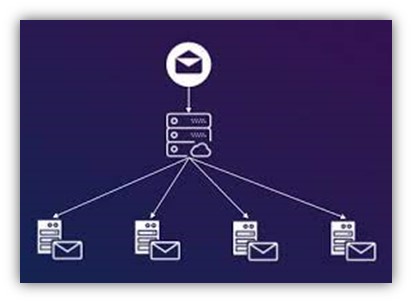
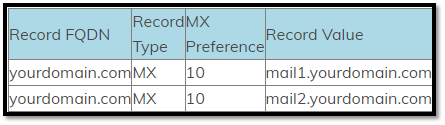
Many mail servers in organizations send and receive a huge amount of emails. Load Balancing structure is used to avoid creating queues and delays in email delivery. When using mail servers, incoming emails should be directed toward different email servers so that the same amount of emails is processed, and the organization can reach a balance. To achieve balance in the email structure, MX Record is used in DNS.
Mail Exchanger or MX is a type of record in DNS that can determine how emails are transferred using the SMTP protocol (to send emails and on port 25) to create load balancing. The MX Record usually retrieves the Fully Qualified Domain Name (FQDN) for email servers.
Multiple MX records can be defined for a domain. One MX record refers to the main server, and other records refer to one or more backup servers. The reason for using multiple MX records is that if one record has a problem, the other records can be used as a backup.